




Table of Contents
Some thinking is done in words.
Some thinking happens before we can put it into words.
For either kind of thinking to become creative – meaning, for it to travel to new places, rather that re-trace the same loop, over and over – there has to be space for something unexpected to emerge.
Here's how the novelist Andrew Hunter Murray describes his hand surprising him when he's writing:
"When longhand writing is working really well, you can find yourself writing a sentence that you weren't aware was in your head. It wasn't in your head, actually.
You don't really know which bit of you it's come from. Your hand has moved and written the words. But there's a really pleasant – and very weird – sensation of being written through.
Now, it's clearly all me, I'm not saying anything else is writing through me, I'm not receiving signals. [Rather], the process of writing longhand means you can access sentences that had not fully formed in your conscious mind, and you access them with the pen."
In other words, the writing helps the thought arrive. The discovery isn't occurring separately from the movement of the hand – it is occurring through it.
Many creative people describe versions of this experience: writers discover sentences; musicians discover melodies; artists discover images.
Paul Klee, an influential Swiss-German painter, once said,
"A drawing is simply a line going for a walk."
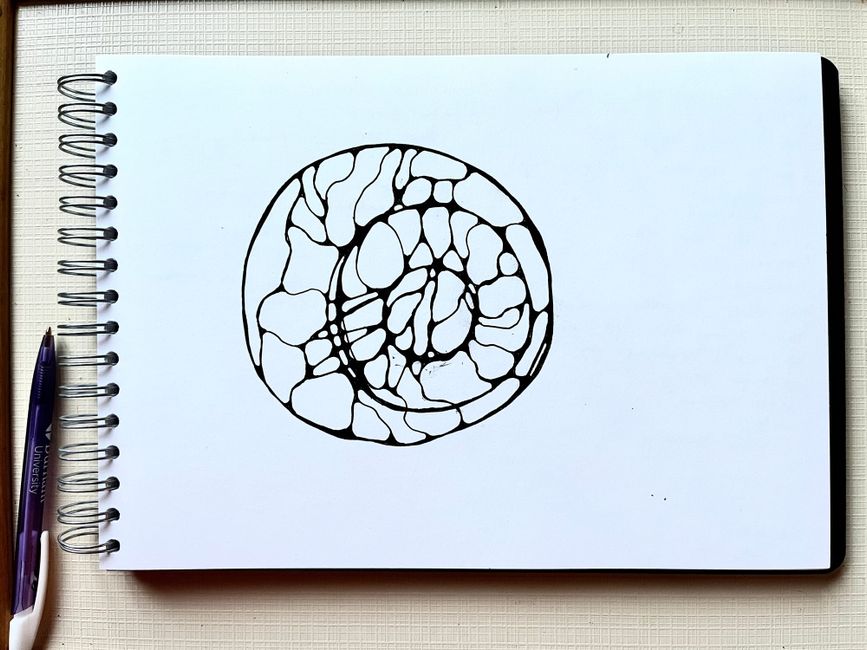
What if moving a line across paper can become a way of thinking?
What if moving a line across paper can become a way of thinking?
In NeuroGraphica, the process itself gives something previously unformed a way to emerge.
Just like with handwriting for the novelist, the NeuroGraphica line is not illustrating a thought that already exists. It is participating in the creation of new thought.
The NeuroGraphica line is not illustrating a thought that already exists. It is participating in the creation of new thought.
In both cases, understanding follows discovery – not the other way round.
Perhaps this is why NeuroGraphica often feels different from simply thinking about a situation. The line is not there to merely to express an idea: the line is helping the idea take shape.
This is one reason NeuroGraphica can sometimes lead to surprising insights. Because the process allows more of us to participate in the conversation. The marker becomes a way of thinking with the whole self, rather than only with the conscious mind.
So NeuroGraphica is not expressing thought. It's helping thought emerge.
It is discovery through doing.
Follow whichever thread is tugging at your curiosity.
If you're wondering how NeuroGraphica works
→ When thinking harder isn't helping
If you'd like to imagine yourself trying it
→ What makes NeuroGraphica different?
If you'd like to take a practical next step
→ NeuroGraphica: draw your dreams




Comments