




Table of Contents
Frustration is an odd thing. On the surface, it seems entirely negative. An unpleasant interruption. Something we'd rather be rid of.
Yet frustration rarely appears at random. We become frustrated when something matters to us. A project that won't move forward. A conversation that never seems to get resolved. A dream that has remained stubbornly out of reach. A situation that keeps repeating itself, despite our best efforts.
If we didn't care, we wouldn't be frustrated.
Frustration is evidence that somewhere underneath it, there is a wish.
Frustration is evidence that somewhere underneath it, there is a wish.
The trouble is that frustration has a way of obscuring the very thing it points towards. The more preoccupied we become with what isn't working, the harder it can be to see what might. Our attention narrows. Our imagination contracts. Possibilities disappear from view.
We find ourselves walking the same mental pathways again and again, hoping that this time they will lead somewhere different.
Sometimes they do. And sometimes we need a different way of approaching the situation altogether.
Suppose I offered you a choice. You could spend another three weeks thinking about the thing that's frustrating you. Or you could spend two hours drawing about it.
Most people would assume the thinking was the sensible option. After all, surely solutions come from thinking?
And yet many of life's most stubborn frustrations have already received an extraordinary amount of thought. We've analysed them. Discussed them. Rehearsed imaginary conversations about them while standing in the shower.
We've revisited them so many times that grooves have formed.
Which raises an intriguing possibility:
What if the problem isn't that you haven't thought about it enough?
What if another kind of conversation is possible?

The wish beneath the frustration
This is where things become interesting.
Because frustration is not merely something to be got rid of. It is often a sign that something important is trying to emerge. Frustration appears when there is a gap between the reality you are experiencing and the reality you would rather inhabit.
Frustration appears when there is a gap between the reality you are experiencing and the reality you would rather inhabit.
In that sense, frustration is strangely revealing. It tells you where to look. Or rather, it points towards something that wants your attention.
A wish.
Not necessarily a grand dream. Sometimes the wish is quite modest: to feel more at ease, to finish what you've started, to have an honest conversation, or perhaps to make room for something new.
To stop carrying the same burden quite so heavily.
The difficulty is that when frustration takes centre stage, the wish can become difficult to see. We become so preoccupied with what is wrong that we lose sight of what we are actually trying to move towards.
We become so preoccupied with what is wrong that we lose sight of what we are actually trying to move towards.
A different kind of conversation
Sometimes a shift in perspective begins with a shift in medium.
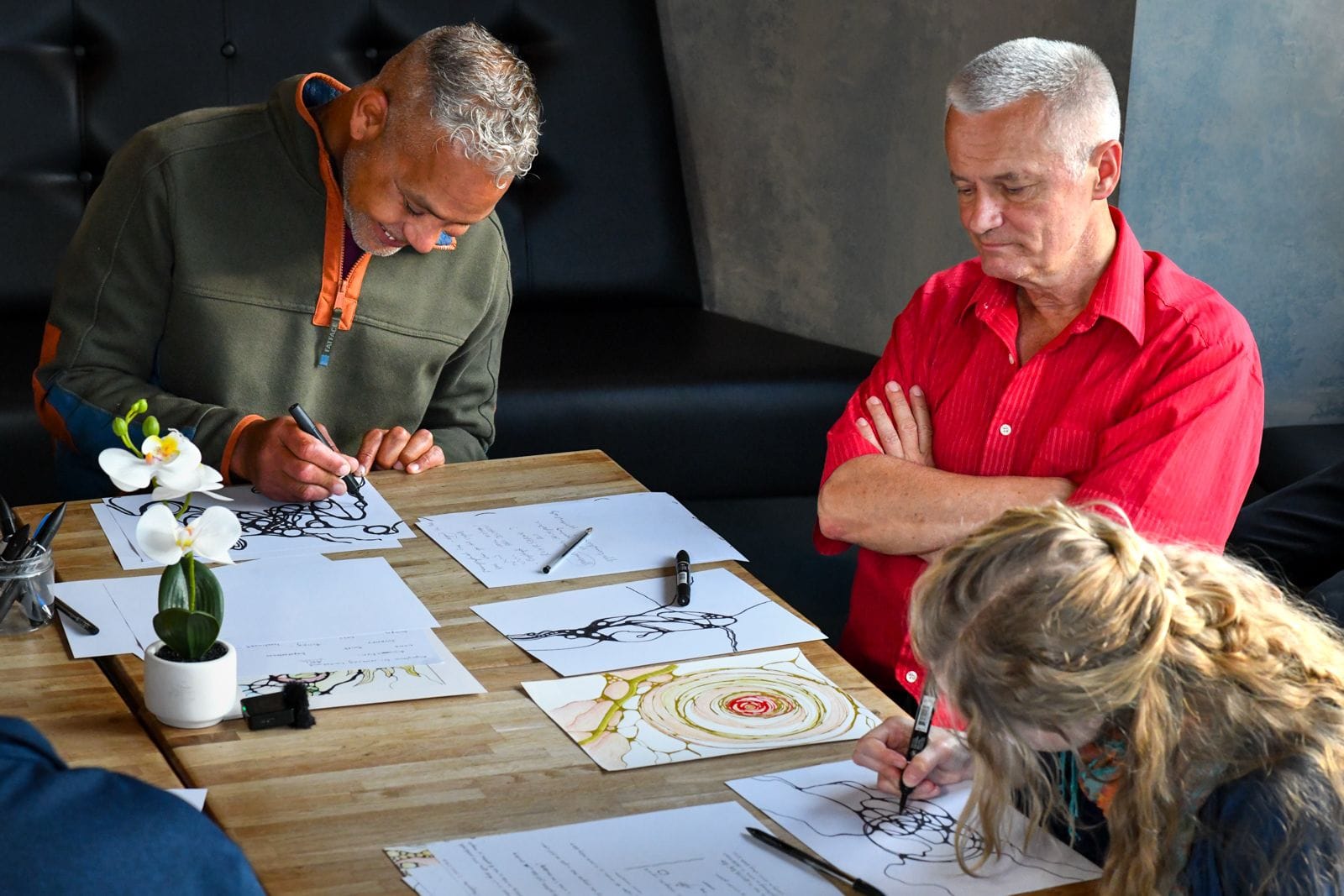
Many approaches begin by asking you to think differently. NeuroGraphica begins somewhere else. It begins with a pen and a sheet of paper.
Rather than trying to force a solution, NeuroGraphica invites you into a process of drawing about the situation.
The aim is not to produce a beautiful picture.
Nor is it to analyse the problem endlessly.
Instead, the drawing becomes a space in which frustration, possibility, imagination and intention can begin to interact in new ways.
People often arrive feeling tangled, constrained or uncertain. What they frequently discover is not an answer but something equally valuable: more room to move, more possibility than they could previously see.
From that place, new actions become imaginable, new choices become available, and what once felt immovable can begin to shift.
The first NeuroGraphica template (ARL) is designed specifically to turn frustration into a doorway.
Beyond it lie many other ways of working with dreams, relationships, choices, projects, identity and possibility.
But first, it helps to create a little space.
Follow whichever thread is tugging at your curiosity.
If you're curious about what's happening beneath the surface
→ Thinking with a Pen
If you'd like to get a feel for the experience
→ What makes NeuroGraphica different?
If you're wondering whether this might be for you
→ NeuroGraphica: draw your dreams




Comments