




Table of Contents
When people first encounter NeuroGraphica, they often assume it's about changing what's happening inside them.
And it is.
But that's only one part of the picture.
3 nested scales
NeuroGraphica offers a way of relating to human experience at three nested scales.
1. Intra-personal
The relationship with oneself.
- thoughts
- emotions
- beliefs
- inner conflicts
- hopes, wishes, values
- self-image
- self-trust
This is where many personal development approaches stop.
2. Inter-personal
The relationship between self and others.
- communication
- boundaries
- belonging
- intimacy
- family
- leadership
- collaboration
- conflict
Changes in the inner world inevitably affect relationships, and relationships continually shape the inner world.
3. Trans-personal
The dimension that extends beyond the individual self.
This is likely the part most worth unpacking because "non-religious spirituality" readers will be especially interested.
Themes:
- meaning
- purpose
- vocation
- values
- beauty
- awe
- creativity
- service
- belonging to something larger than oneself
The trans-personal concerns those experiences in which life feels larger than our individual concerns. Moments when we feel connected to meaning, beauty, truth, nature, humanity, creativity, or a deeper sense of purpose.
The levels interact
NeuroGraphica offers ways of working across all three levels. It sees them not as three separate domains, but as three interwoven dimensions of experience.
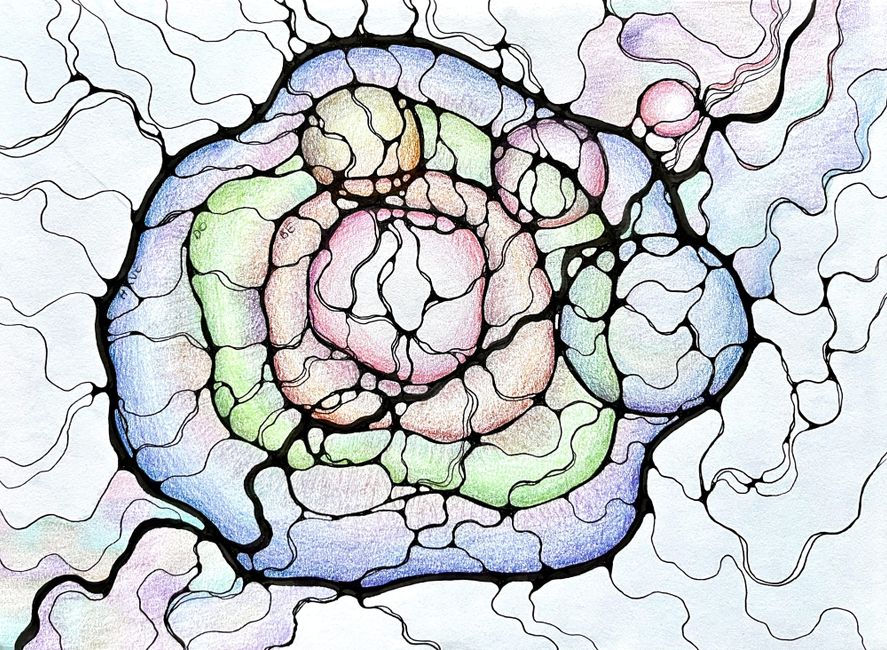
A drawing may begin with a specific problem, yet reveal patterns in our relationships, and eventually open questions of meaning, purpose, and possibility.
A workplace conflict may appear interpersonal.
Yet it may reveal:
- an intrapersonal fear of rejection
- and a transpersonal question about integrity and purpose.
Or, to start from a different level:
A longing for a more meaningful life may appear transpersonal.
Yet it may require:
- intrapersonal courage
- interpersonal conversations and relationships
to become reality.
I get asked, How can the same method be used for dreams, relationships, identity, purpose, decision-making, communication, and life transitions?
The simplest way to answer:
Because all of those belong to one of three conversations humans are constantly having.
The challenges that bring us to inner work rarely stay neatly in one category.
They move between self, relationship, and meaning.
Perhaps the art is not deciding which level matters most, but learning to listen to all three.
Follow whichever thread is tugging at your curiosity.
If you're interested in the thinking behind this
→ A friendly universe
If you'd like to imagine yourself trying this
→ NeuroGraphica: draw your dreams
If you're wondering whether this might be for you
→ Preparing to attend a NeuroGraphica workshop




Comments