




Table of Contents
When people first come across NeuroGraphica, they often try to understand it by comparing it to something they already know.
“Is it a kind of art therapy?”
“Is it like intuitive drawing?”
“Is it a mindfulness practice?”
“Is it visual journaling?”
NeuroGraphica does share something with all of those approaches. It can help people access feelings, insight, reflection, imagination, calm, clarity, and creativity.
But none of those descriptions quite captures the essence of what NeuroGraphica does.
Many practices help you explore your inner world. NeuroGraphica also helps you actively work with it.
That may sound like a small distinction, but in practice it creates quite a different experience.
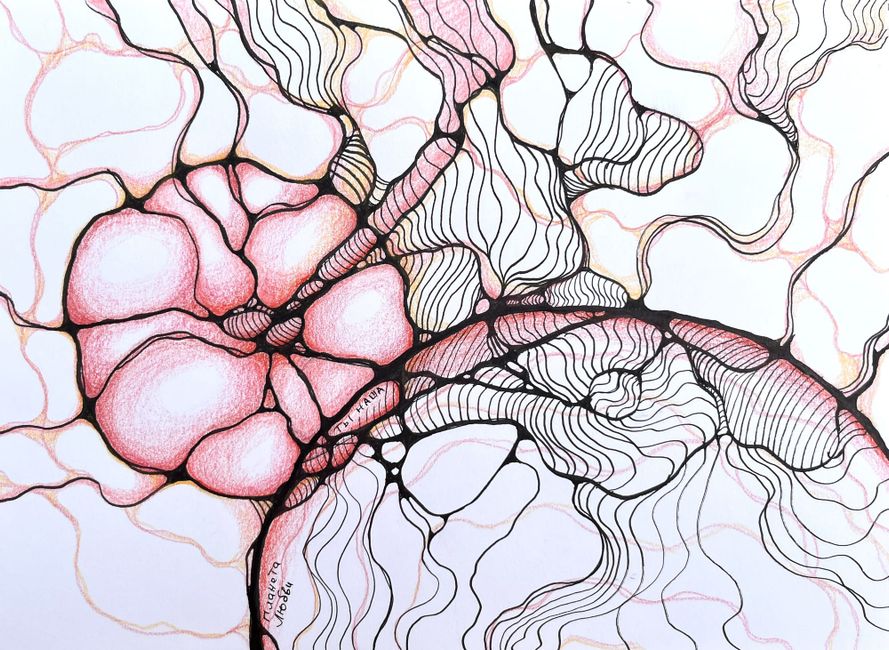
NeuroGraphica is also sometimes confused with “NeuroArt”, an artistic style that uses visually similar flowing forms — though the two are quite different in purpose and orientation.
Similar-but-different
If you think NeuroGraphica sounds a bit like art therapy, that makes sense. Both involve drawing, emotion, symbolism, and self-discovery. Both can help people access things that are difficult to put into words.
But art therapy is usually focused more on expression, exploration, and understanding. The drawing may become part of a conversation with the therapist about what it represents, what feelings it connects to, what story it tells.
NeuroGraphica works rather differently.
In NeuroGraphica, you do not need to explain your drawing or interpret every shape and colour. The focus is less on analysing the story and more on working with the pattern itself.
The focus is less on analysing the story and more on working with the pattern itself.
Lines connect. Tension softens. Separate elements begin relating to one another differently. The drawing changes — and often your experience of the situation changes alongside it.
Art therapy often asks:
“What wants to be expressed?”
NeuroGraphica also asks:
“What would you like to transform?”
Some people compare NeuroGraphica to intuitive art or free-flow drawing. That comparison also makes sense, because NeuroGraphica can feel spontaneous, surprising, and freeing.
But there is an important difference here too.
Purely intuitive drawing often emphasises complete freedom and unrestricted expression. NeuroGraphica works with freedom, but it also includes structure.
There are specific methods, principles, and sequences within the process. So although the drawing may feel organic and alive, it is not entirely random.
The structure is there to help guide change.
The structure is there to help guide change.
Oddly enough, many people find that the structure actually creates more freedom, not less. Instead of staring at a blank page wondering what to do, they can begin interacting with the process straight away.
Other people compare NeuroGraphica to journaling or reflective practices. And again, there is a genuine overlap. Both can help you process experience, notice patterns, and gain insight.
But journaling mainly works through words and narrative.
NeuroGraphica works more through image, movement and spatial relationships.
Sometimes people discover things by writing them down. Sometimes they discover things by interacting visually and physically with a page.
NeuroGraphica gives the mind another language to think in.
NeuroGraphica gives the mind another language to think in.
Then there is the comparison with mindfulness or meditation. Many people do experience NeuroGraphica as calming. The repetitive movements, focused attention, and slower pace can create a sense of quiet and presence.
But NeuroGraphica is not only about observing your experience. It's also about using your intention.
You are not simply witnessing what is happening internally. You are participating in a process that reshapes relationships, associations, and possibilities inside the drawing itself.
This is why I often describe NeuroGraphica as both expressive and constructive.
You're not only “getting things out”. You're also building new connections.
You're not only ‘getting things out’. You're also building new connections.
And importantly, NeuroGraphica is not about being good at art.
You do not need artistic training. You do not need to produce something polished or beautiful. In fact, many people come to NeuroGraphica precisely because they do not think of themselves as artistic at all.
The point is not performance. The point is inner transformation.
Inner shifts for tangible change
Some people experience NeuroGraphica as therapeutic. Some find it meditative. Some discover clarity, emotional relief, momentum or unexpected ideas through the process.
But NeuroGraphica itself is not psychotherapy, and it is not simply doodling for relaxation either.
It is a structured creative method for working with change.
People often come to NeuroGraphica not only because they want to feel differently, but because they want to live differently: to make decisions, begin projects, resolve conflicts, move through uncertainty, or create new possibilities in their outer lives.
This is one of the reasons NeuroGraphica is often used alongside real-world projects and transitions.
As inner patterns shift, people often find that new actions, choices, and directions become available to them.
Follow whichever thread is tugging at your curiosity.
If you'd like to understand this a little more deeply
→ Thinking with a Pen
If you'd like to explore this through a different lens
→ NeuroGraphica: draw your dreams
If you're wondering whether this might be for you
→ Preparing to attend a NeuroGraphica workshop




Comments